A Modular Parity Decomposition of the Riemann Zeta Function and Its Asymptotic Floor Boundary
We present a modular parity decomposition of the Riemann Zeta function partitioned modulo 4 into its constituent Hurwitz sub-series. By analyzing the parity sums, alternating series differences, and cross-parity ratios, we isolate the transcendental complexity of the system into a single parameter-free coordinate remainder, \(k(n)\). We establish that \(k(n)\) converges asymptotically to \(1\) within an exponential bound contracting at the rate of \((2/3)^n\), and analyze the floor boundary conjecture \(\lfloor \zeta(n, 3/4)/\zeta(n) \rfloor = \lfloor (4/3)^n \rfloor\) for \(n \ge 2\), connecting discrete Diophantine boundaries to continuous modular L-functions. We provide the complete three-sector analytic coordinate formulas mapping the discrete algebraic scaffold directly to classical Dirichlet and Hurwitz series.
1. Modular Parity Decomposition and Analytic Foundations
The Riemann Zeta function \(\zeta(n)\) decomposes modulo 4 into four constituent sub-series indexed by the residue class of the summation variable, formulated via the Hurwitz zeta function \(\zeta(n, a)\):
Linear combinations of these modular sub-series yield the parity direct sums and alternating series:
where \(\eta(n)\) is the Dirichlet Eta function and \(\beta(n)\) is the Dirichlet Beta function. Subtracting \(2^n\) from \(K(n)\) defines the parameter-free coordinate remainder \(k(n)\):
The coordinate remainder \(k(n)\) isolates the non-rational coordinate displacement of the odd-parity Dirichlet sub-series relative to the even-parity baseline.
2. Three-Sector Analytic Coordinate Verification Matrix
| Even Parity \(\zeta\) | Parent View | Odd Parity \(\zeta\) | |||
|---|---|---|---|---|---|
| \(\frac{1}{2}\cdot 4^{-n}(\zeta(n,2/4)+\zeta(n,4/4))\) | \(\frac{1}{2}\cdot 4^{-n}(\zeta(n,2/4)-\zeta(n,4/4))\) | \(\frac{1}{2}\zeta\) | \(\frac{1}{2}\eta\) | \(\frac{1}{4}(\zeta + \eta)\) | \(\frac{1}{4}(\beta + \beta)\) |
| \(4^{-n}\zeta(n,2/4)\) | \(4^{-n}\zeta(n,4/4)\) | \(\frac{1}{2}(\zeta + \eta)\) | \(\frac{1}{2}(\zeta - \eta)\) | \(\frac{1}{4}((\zeta + \eta) + 2\beta)\) | \(\frac{1}{4}((\zeta + \eta) - 2\beta)\) |
| \(4^{-n}(\zeta(n,2/4)+\zeta(n,4/4))\) | \(4^{-n}(\zeta(n,2/4)-\zeta(n,4/4))\) | \(\zeta\) | \(\eta\) | \(\frac{1}{2}(\zeta + \eta)\) | \(\frac{1}{2}(\beta + \beta)\) |
3. The \(\beta - \eta\) Verification Sector
Subtracting the alternating Dirichlet series \(\eta(n)\) from the Dirichlet Beta series \(\beta(n)\) isolates the parameter-free coordinate remainder \(k(n)\) within the odd-parity partitions:
| Odd Parity \(\beta - \eta\) Sector | |
|---|---|
| \(\frac{1}{4}(\zeta - \eta)\) | \(\frac{1}{4}\cdot 2(\beta - \eta)\) |
| \(\frac{1}{4}((\zeta - \eta) + 2(\beta - \eta))\) | \(\frac{1}{4}((\zeta - \eta) - 2(\beta - \eta))\) |
| \(\frac{1}{2}(\zeta - \eta)\) | \(\beta - \eta\) |
4. Coordinate Definitions and Odd Parity Representation
From the \(\beta - \eta\) verification sector, we define coordinates \(X(n)\) and \(Y(n)\):
5. Asymptotic Convergence and Exponential Bounds
Expanding \(\beta(n)\) and \(\eta(n)\) in their classical Dirichlet series:
\[ \beta(n) = 1 - 3^{-n} + O(5^{-n}), \quad \eta(n) = 1 - 2^{-n} + 3^{-n} + O(4^{-n}) \]The series expansion of their ratio yields:
\[ \frac{\beta(n)}{\eta(n)} = 1 + 2^{-n} - 2\cdot 3^{-n} + O(4^{-n}) \]Substituting into \(k(n)\):
\[ k(n) = 2^n \left( \frac{\beta(n)}{\eta(n)} - 1 \right) = 1 - 2\left(\frac{2}{3}\right)^n + O(2^{-n}) \]Consequently, \(\lim_{n \to \infty} k(n) = 1\) and the remainder satisfies the exponential bound:
6. Asymptotic Analysis and Floor Boundary Conjecture
Define the normalized coordinate ratio \(A(n) = \frac{\zeta(n, 3/4)}{\zeta(n)}\). The difference between \((4/3)^n\) and \(A(n)\) is:
Since \(4k+3 > 3k+3 > 0\) for all integers \(k \ge 1\), every term in the sum is strictly positive, establishing \(\delta(n) > 0\) and \(A(n) < (4/3)^n\) for all \(n \ge 1\). The leading term at \(k=1\) yields \(\delta(n) = \Theta((2/3)^n)\).
| \(n\) | \((4/3)^n\) | Distance to Floor | \(A(n) = \zeta(n,3/4)/\zeta(n)\) | Difference \(\delta(n)\) | \(\lfloor A(n) \rfloor\) | \(\lfloor (4/3)^n \rfloor\) |
|---|---|---|---|---|---|---|
| 2 | 1.77777778 | 0.77777778 (7/9) | 1.54527753 | 0.23250025 | 1 | 1 |
| 3 | 2.37037037 | 0.37037037 (10/27) | 2.20564983 | 0.16472054 | 2 | 2 |
| 4 | 3.16049383 | 0.16049383 (13/81) | 3.07689108 | 0.08360275 | 3 | 3 |
| 5 | 4.21399177 | 0.21399177 (52/243) | 4.17523992 | 0.03875185 | 4 | 4 |
| 6 | 5.61865569 | 0.61865569 (451/729) | 5.60100416 | 0.01765153 | 5 | 5 |
Letting \(\{x\} = x - \lfloor x \rfloor\) denote the fractional part, the condition for the floor identity \(\lfloor A(n) \rfloor = \lfloor (4/3)^n \rfloor\) to hold is equivalent to the Diophantine inequality:
Conjecture 1 (Floor Boundary Conjecture). For all integers \(n \ge 2\):
This relationship has been verified computationally for all integers \(2 \le n \le 50,000\).
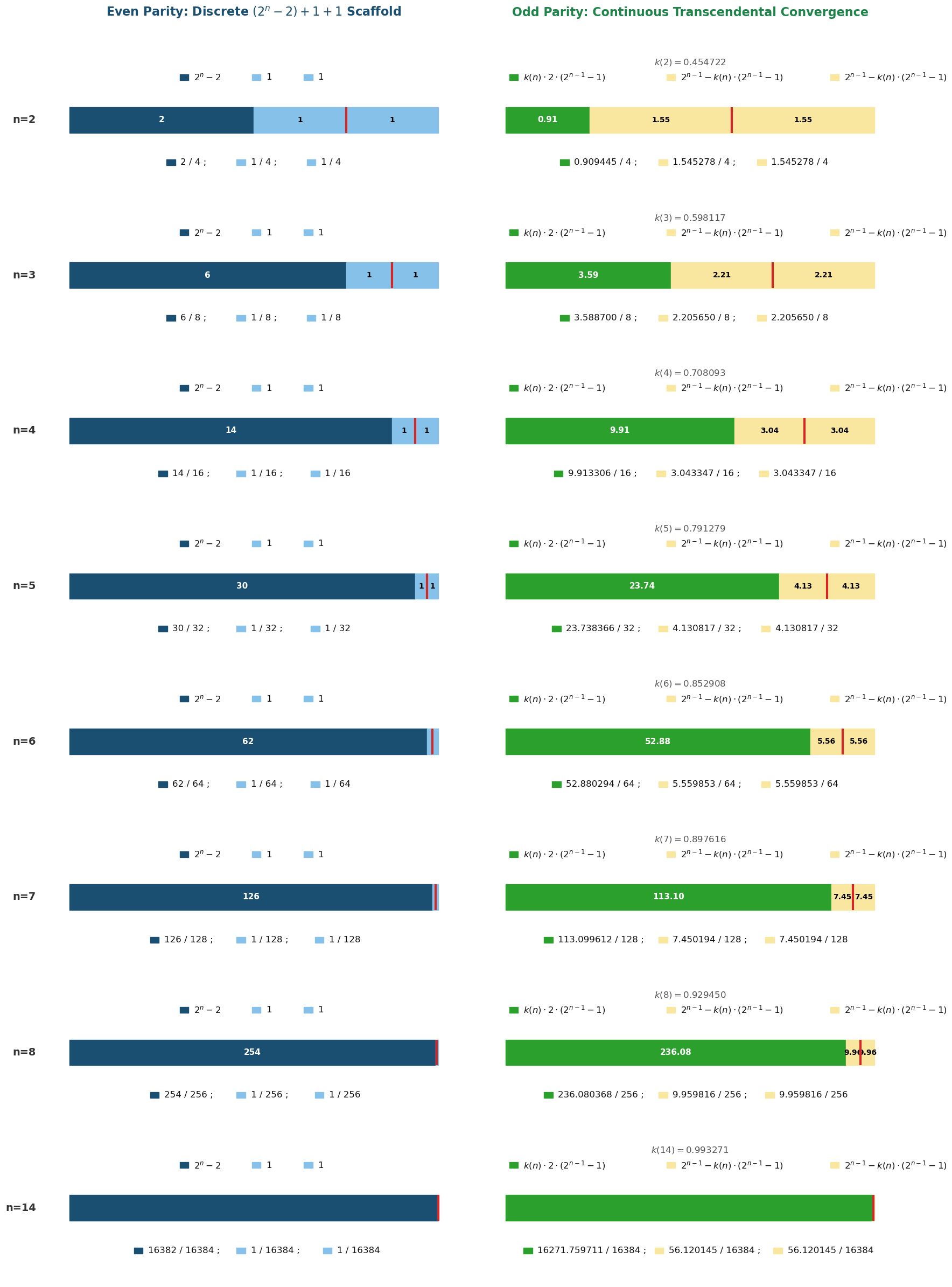
7. Modular Parity Partition Convergence
8. Discussion and Future Directions
The modulo-4 partition separates the Riemann Zeta function into an even-parity sector whose sub-series evaluate to rational multiples of \(\zeta(n)\) and \(\eta(n)\), and an odd-parity sector parameterized by the coordinate remainder \(k(n) = 2^n(\beta(n)/\eta(n) - 1)\). The exponential contraction \(|k(n)-1| \le 2(2/3)^n\) establishes that the odd-parity sub-series asymptotically recover the structural symmetry of the even-parity sector.
Direct avenues of research include investigating the algebraic structure of \((2^n-2)k(n)\) across odd integer arguments, extending coordinate definitions \(X(s), Y(s)\) into the critical strip, and generalizing modular partitions to higher bases modulo \(2m\).
References
- Apostol, T. M. (1976). Introduction to Analytic Number Theory. Undergraduate Texts in Mathematics, Springer-Verlag, New York.
- Dirichlet, P. G. L. (1837). Beweis des Satzes, dass jede unbegrenzte arithmetische Progression, deren erstes Glied und Differenz ganze Zahlen ohne gemeinschaftlichen Factor sind, unendlich viele Primzahlen enthält. Abhandlungen der Königlichen Preußischen Akademie der Wissenschaften zu Berlin, 45–81.
- Hurwitz, A. (1882). Einige Eigenschaften der Dirichlet'schen Functionen \(F(s) = \sum (D/n) 1/n^s\), die bei der Bestimmung der Classenzahlen binärer quadratischer Formen auftreten. Zeitschrift für Mathematik und Physik, 27, 86–101.
- Mahler, K. (1968). An unsolved problem on the powers of 3/2. Journal of the Australian Mathematical Society, 8(2), 313–321.
- Montgomery, H. L., & Vaughan, R. C. (2007). Multiplicative Number Theory I: Classical Theory. Cambridge Studies in Advanced Mathematics, Cambridge University Press.
- Titchmarsh, E. C. (1986). The Theory of the Riemann Zeta-Function (2nd ed., revised by D. R. Heath-Brown). Oxford University Press.